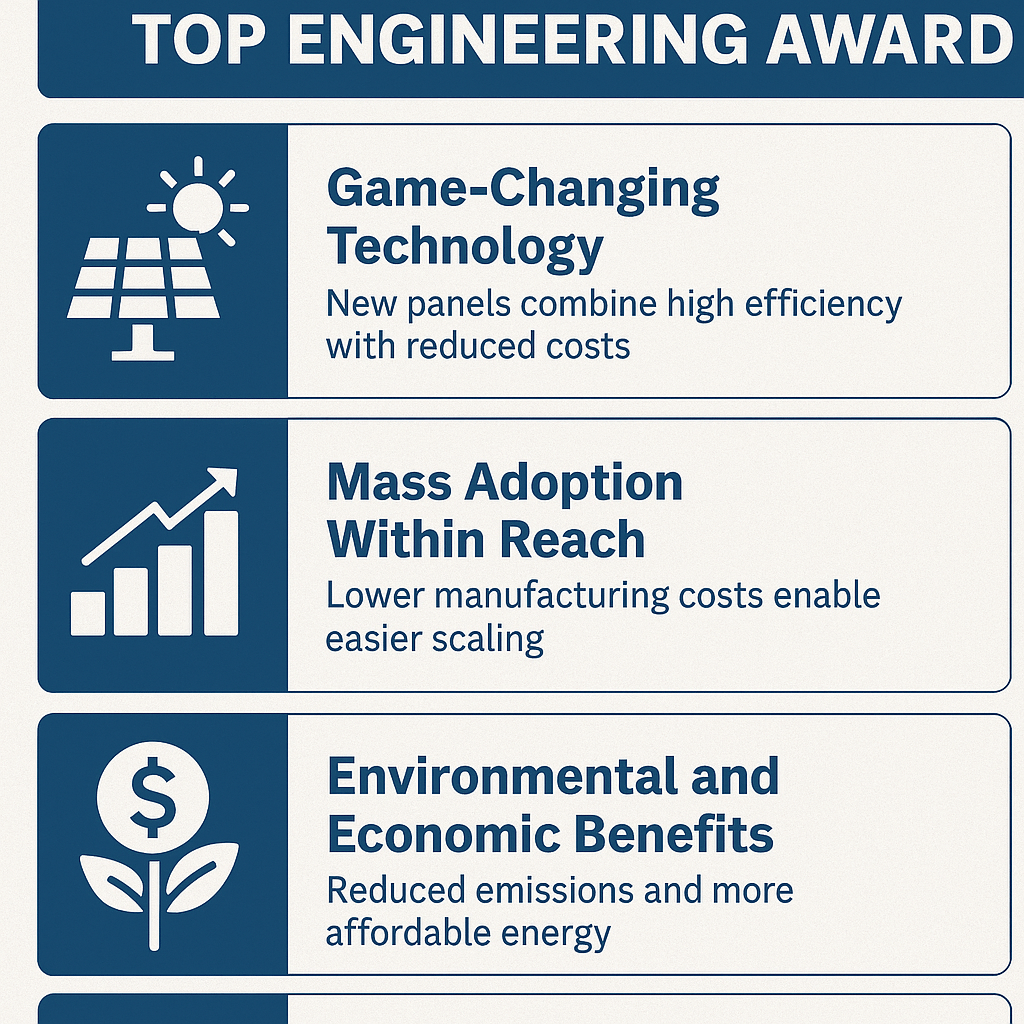
Solar Panels Energy Costs Make a Low-Cost, High-Efficiency model Win the Top Engineering Award
Innovation in solar panel energy costs just reached a new milestone. A team of engineers has developed next-generation solar panels that combine high efficiency with low production costs—and they’ve earned major recognition for it.
Solar Panel Energy Costs Got Cheaper: Game-Changing Solar Technology
Developed by a research team led by Stanford and MIT scientists, these solar panels deliver record-setting energy output without the high price tag. The secret lies in advanced materials and streamlined manufacturing. These improvements reduce costs while boosting performance.
The panels are made using thin-film technology and multi-junction architecture, which enables them to capture more of the sun’s spectrum. As a result, they achieve a solar conversion rate far above standard silicon models.
This breakthrough caught the attention of the Institute of Electrical and Electronics Engineers (IEEE). The group awarded the technology a top global engineering prize for innovation and sustainability impact.
Why It Matters
Traditional solar panels often force buyers to choose between price and performance. High-efficiency models usually cost more and take longer to pay off. Meanwhile, budget panels can be less reliable or produce less power.
This new solar panel design solves that dilemma. It offers the kind of output typically seen in premium products—but at a fraction of the cost. That’s a big win for both homeowners and large-scale solar developers.
As solar adoption continues to grow, the need for efficient, affordable solutions becomes urgent. These panels help meet that demand.

Mass Adoption Within Reach
By reducing production complexity and materials costs, the developers made the panels easier to scale and cheaper to ship. That makes them ideal for both residential rooftop systems and large solar farms.
The panels are also lightweight and durable, making them suitable for a variety of climates and installation types. Early tests show they hold up well in extreme heat, snow, and high winds.
In short, this technology removes key barriers to clean energy access—cost, durability, and efficiency.
Environmental and Economic Benefits
Widespread adoption of this solar tech could lead to:
- Lower installation costs
- Faster return on investment
- Reduced fossil fuel dependence
- Fewer carbon emissions
- More green jobs in solar manufacturing and construction
In fact, the U.S. Department of Energy estimates that scaling high-efficiency solar can cut energy bills by up to 60% over a system’s lifetime.
A Win for the Clean Energy Movement
Recognition by IEEE highlights just how important these breakthroughs are. This award doesn’t just honor engineering excellence—it signals a turning point for the solar industry. With affordability no longer holding back efficiency, the global transition to clean power just got a major boost.
Final Thoughts
Affordable, high-efficiency solar panels are no longer a dream. Thanks to this award-winning innovation, clean energy just became more accessible to more people. As the technology hits the market, it could transform how we power homes, cities, and entire countries.
This is the kind of solar breakthrough the world has been waiting for—and it’s finally here.
Learn More:
🔗 U.S. Department of Energy – Solar Energy Technologies Office
🔗 IEEE Honors Engineering Breakthroughs
Professor Wenham will give a special lecture, which will also be available to watch live online, on 21 May 2014 to commemorate his award of the A F Harvey Engineering Prize. For more details, visit: http://www.theiet.org/harvey
Source: The IET
A solar panel in Marla, Cirque de Mafate, Réunion
Copyright © 2005 David Monniaux