
BEV Market: A Charged Up Landscape
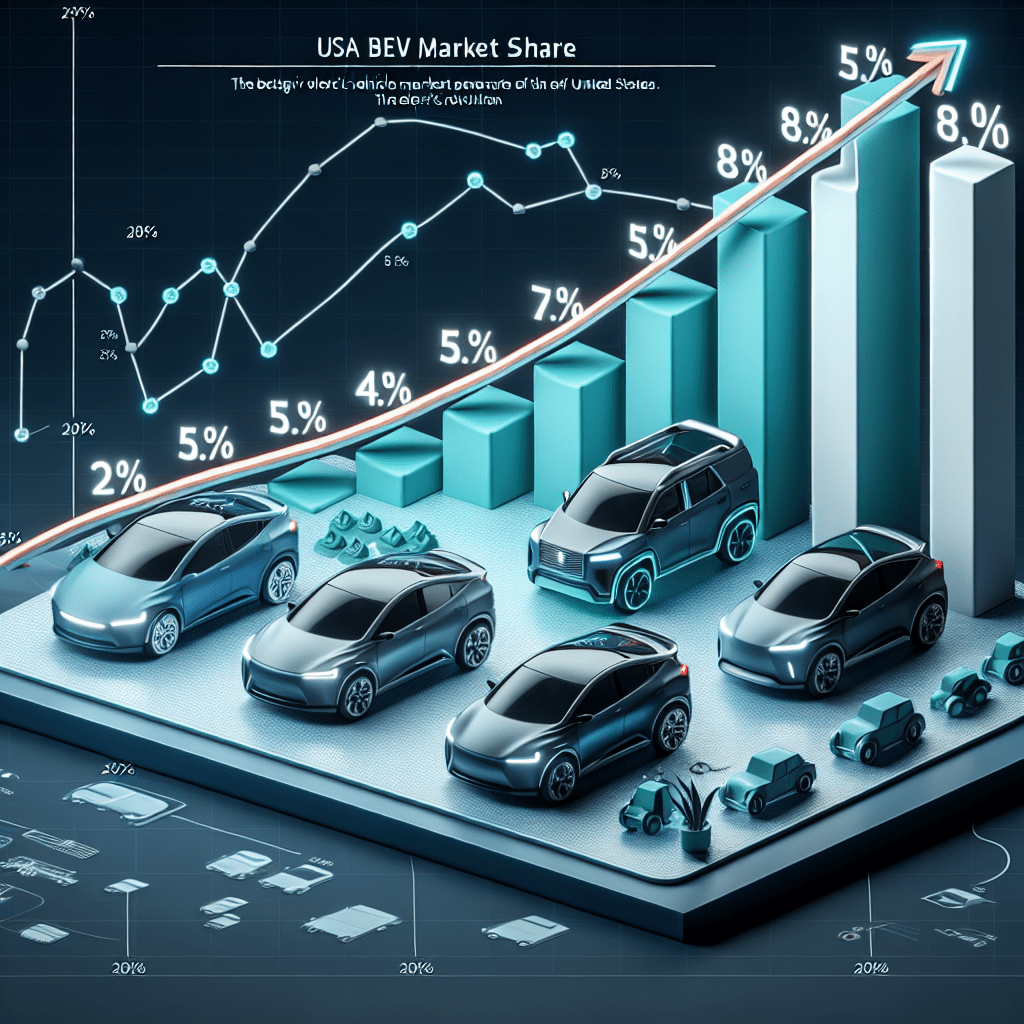
A seismic shift reshapes the America’s automotive landscape. Most notably as battery electric vehicles (BEVs) surge to capture an unprecedented 8% share of the U.S. auto market. This milestone was reached in the second quarter of 2024. For it also marks a pivotal moment in the nation’s transition to sustainable transportation. The rapid growth of BEVs signals a transformative era. Especially toward propelling the country to a greener automotive future.
BEV Market: Breaking Down The Numbers
The numbers also tell a compelling story. Excitingly, BEV sales have skyrocketed to 330,463 units in Q2 2024. That’s most notably representing a robust 22.9% increase from the previous quarter. In addition, it’s 11.3% year-over-year growth. This acceleration in adoption rates signals a growing acceptance of EVs. Especially of electric vehicles among all American consumers.

Tesla’s Reign and Rising Competitors in BEV Market
Clearly, as we have seen Tesla leads. Yet it’s also with 49.7% of the BEV market. Yet its dominance faces challenges. Tesla’s share dipped below 50% for the first time. This indicates a diversifying field. Traditional automakers also. are making significant inroads. For example, Ford reports a 61.4% year-over-year increase in EV sales. They moved 23,957 units in Q2 2024.
General Motors sold 21,930 BEVs in the same quarter. Surprisingly, Hyundai and also Kia outpaced Ford. They collectively sold 37,044 EVs across their brands. This competition drives innovation. It expands consumer choice, fueling the electric revolution.
Policy Drives Progress
The surge in EV adoption can also be attributed to a confluence of factors. Growing environmental consciousness among consumers, coupled with government incentives and an expanding charging infrastructure, has made EVs increasingly attractive. The Biden administration’s push for cleaner transportation has undoubtedly played a role, as have state-level incentives that have made BEVs more accessible to the average American consumer.
Environmental Impact
As BEV adoption rises, so does the potential for significant carbon emission reductions. Experts project that this shift could lead to a decrease of up to 101,867 TCO2E over the vehicles’ lifecycle. That’s aligning with broader climate goals and demonstrating the tangible environmental impact of the electric vehicle industry and charging station transition.
The Road Ahead for your electric vehicle market
Looking ahead, the future of the EV market in the United States appears charged with potential. Projections suggest that the Electric Vehicles market will reach a revenue of $94.9 billion in 2024, with an expected annual growth rate of 10.49% through 2029. By that year, the market volume is anticipated to hit $156.3 billion, with unit sales reaching a staggering 2.32 million vehicles.
However, challenges remain on the road to full electrification. The average price of a new EV remains a potential roadblock for many consumers, hovering around $60,000, with the volume-weighted average price in the U.S. expected to be $67,300 in 2024. Range anxiety and charging infrastructure continue to be hurdles for potential buyers. Nevertheless, with automakers investing heavily in technology and the government backing the transition, these obstacles are expected to diminish over time.
Finally an electric vehicle market will grow
As America charges towards a cleaner automotive future, the electrification of personal transport is no longer a distant dream but a tangible reality. With each passing quarter, more Americans are plugging into the benefits of battery electric vehicles, driving a transformation that promises to reshape our cities, our air quality, and our relationship with personal mobility.
The road ahead is electric, and the journey has only just begun. As BEVs continue to gain market share, they’re not just changing what we drive – they’re redefining our entire approach to transportation. In this new era of mobility, the question is no longer whether electric vehicles will become mainstream, but how quickly they’ll become the new normal on American roads.
Sources
1. The electric vehicle revolution in the United States is charging ahead at an unprecedented pace. As of Q2 2024, battery electric vehicles (BEVs) have captured an 8.0% market share of new car sales, a significant leap from 5.3% in Q1 2022 2.
2. This growth translates to 330,463 BEVs sold in Q2 2024 alone, marking a 22.9% increase from the previous quarter and an 11.3% year-over-year rise 2.
3. The landscape of the EV market is evolving rapidly. Tesla, long the dominant player, has seen its market share dip below 50% for the first time, settling at 49.7% in Q2 2024 2.
4. This shift signals a more competitive and diverse EV market, with traditional automakers and new entrants gaining ground.
Ford Motor Company
Ford Motor Company, for instance, has shown remarkable growth, selling 23,957 electric vehicles in Q2 2024, a 61.4% increase year-over-year 2. General Motors is not far behind, with 21,930 BEVs sold in the same quarter 2. Perhaps most surprisingly, the Hyundai Motor Company and Kia have surpassed Ford, collectively selling 37,044 EVs across their brands 2.
The surge in EV adoption is driven by several factors. Consumer demand for environmentally friendly transportation options is on the rise, with growing awareness of the impact of traditional gasoline-powered vehicles on the environment 3. Government incentives and expanding charging infrastructure are also playing crucial roles in making EVs more accessible and appealing to a broader range of consumers 3.
Looking Ahead
Looking ahead, the future of the EV market in the United States appears bright. Projections suggest that the Electric Vehicles market will reach a revenue of US$94.9 billion in 2024, with an expected annual growth rate (CAGR 2024-2029) of 10.49% 3. By 2029, the market volume is anticipated to hit US$156.3 billion, with unit sales reaching 2.32 million vehicles 3.
However, challenges remain. The average price of a new EV hovers around $60,000, with the volume-weighted average price in the U.S. expected to be US$67,300 in 2024 13. While this price point may be a barrier for some consumers, the increasing variety of EV models and ongoing technological advancements are likely to drive costs down in the coming years.
Finally, the U.S. continues to electrify its automotive landscape. So it’s also clear that the transition to EVs is no longer a question of if, but when. With each passing quarter, America inches closer. Most notably to a future where electric vehicles are not just an alternative. For they are the norm.
