Let’s talk about the new Octopus Charge EV driver app. Public EV charging should feel simple. Yet many drivers still carry a phone full of charging apps.
One app finds the station. Another starts the session. A third handles payment. Sometimes, the charger requires a fourth account or a separate RFID card.
Octopus Energy now wants to change that experience.
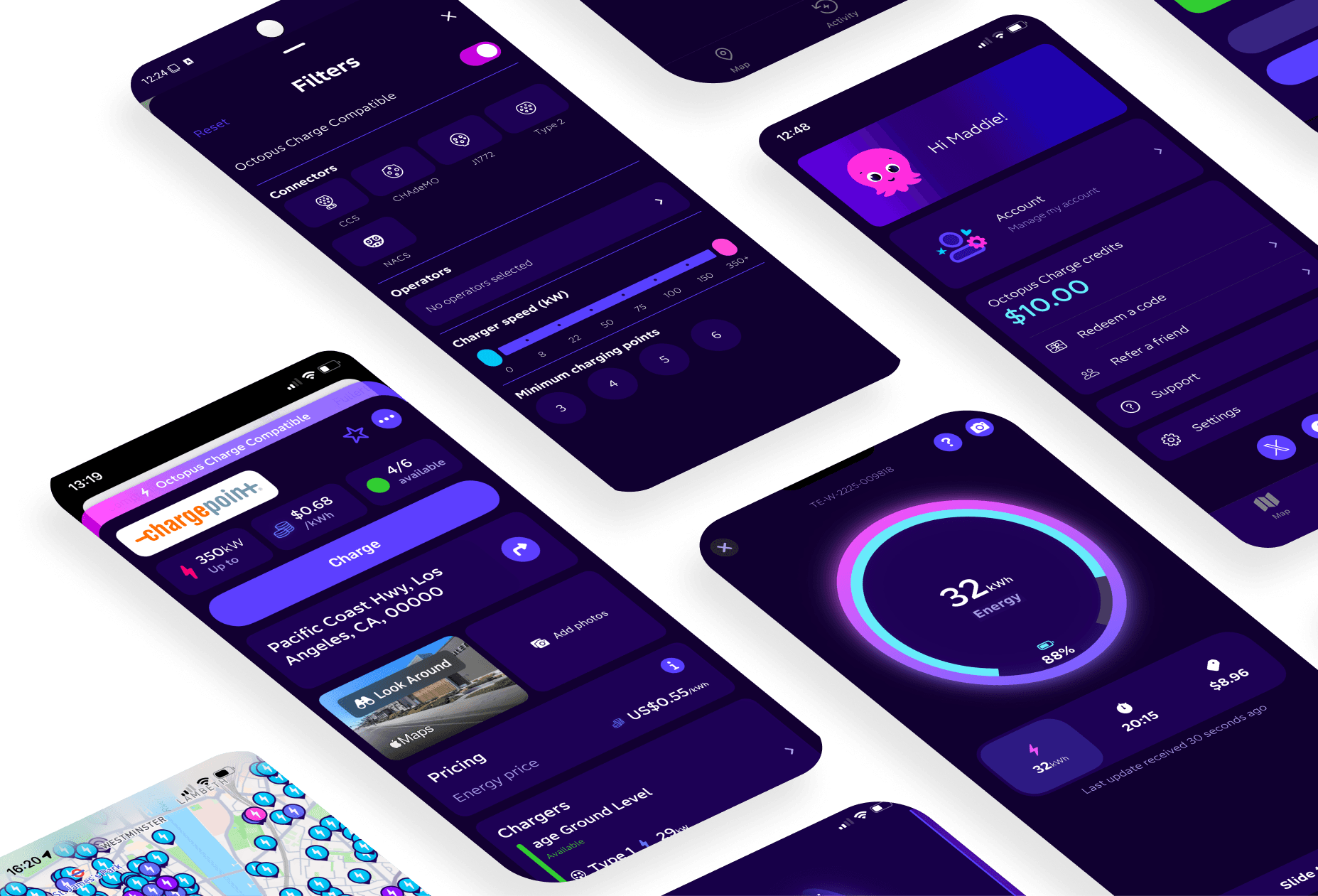
The company launched Octopus Charge, a free iOS and Android app that brings more than 211,221 public EV chargers across North America into one platform. Drivers can use the app to find, start, and pay for charging without managing a separate account for every network.
That may sound like a small software update. However, it addresses one of the biggest frustrations in electric vehicle ownership.
Range anxiety gets most of the attention. In everyday driving, app and payment anxiety can feel just as real.
What Is the Octopus Charge Driver App?
Octopus Charge acts as a single access point for public charging networks in the United States and Canada.
At launch, the app supports 24 partner networks. Those networks include:
- ChargePoint
- AppleGreen Electric
- EVgo
- Blink
- bp pulse
- Shell Recharge
- FLO
- EV Connect
- Circle K
- Circuit Électrique
- FPL EVolution
- Lynkwell
- Red E
- EVCS
- SWTCH Energy
- Hypercharge
- Monta
- Stay N Charge
The full partner list also includes networks such as ABM, ZEF Energy, Flash Parking EV Charging Network, ChargerQuest, EVoke, and Couche-Tard Recharge.
As a result, drivers get access to a much larger charging map from one account. They can search by location or ZIP code. They can also filter results by:
- Charging speed
- Connector type
- Charging network
- Current availability
The Octopus Charger driver app displays charger compatibility, estimated charging speed, prices, and nearby amenities. It also includes a route planner designed for EV trips.
That combination matters. A large map helps drivers find a charger. Detailed information helps them choose the right charger before they arrive.
One App Attacks the Worst Part of Public Charging
The physical charger is only part of the public charging experience.
Drivers also have to deal with software. They may need to download an app, create an account, add a payment method, verify an email address, and then start a session. That process becomes especially frustrating when a driver arrives with a low battery and poor cell service.
Meanwhile, many stations still use different payment systems. Some accept contactless payment. Others direct drivers to a network app. A few require a membership or account before charging begins.
Octopus Charge driver app tries to remove those steps.
The company says drivers can find, start, and pay for charging through its app. Joining is free. Octopus also says it passes through each network’s price without adding a markup to the per-kilowatt-hour cost.
That does not make every charging session inexpensive. Network pricing still varies by location, speed, time, and provider. Nevertheless, the app gives drivers one place to see the applicable price before they plug in.
That kind of transparency can make trip planning easier.
Octopus Charge Driver App Arrives as Charging Reliability Improves
The timing is important.
The 2026 J.D. Power U.S. EVX Public Charging Study found that public charging satisfaction remains uneven. In particular, satisfaction with public Level 2 charging dropped 12 points to 595 on a 1,000-point scale.
The biggest trouble spots involved ease of payment and ease of starting a charging session.
In other words, drivers did not simply want more chargers. They wanted chargers that worked and accepted payment without unnecessary effort.
The industry has started addressing the reliability side of that problem. Automaker-backed networks such as IONNA, Mercedes-Benz Charging, and Rivian’s charging network have added more dependable options for some drivers.
The next challenge involves convenience.
Octopus Charge targets that challenge directly. It does not build a new charging network at every location. Instead, it connects existing networks through a common digital experience.
That approach could deliver benefits quickly. Drivers do not have to wait for thousands of new stations to appear. They can use one app to access stations that already exist.
For more background on the changing charging market, see our coverage of the EVgo supercharger expansion.
What the App Means for an Everyday EV Driver
Consider a typical weekend trip.
You leave home with a partially charged battery. Halfway to your destination, you decide to stop for 20 minutes. Instead of searching through several network apps, you open Octopus Charge and enter a ZIP code or destination.
You filter the results for a compatible fast charger. Then, you check the station’s live availability, charging speed, price, and nearby amenities.
A station with a grocery store or coffee shop may work better than a slightly faster station in an isolated parking lot. The app helps you make that choice before you arrive.
Once you reach the location, you start and pay for the charging session in the same app.
The process still depends on the individual network and the accuracy of its live data. A charger listed as available can become occupied before you arrive. A station can also experience a hardware problem that the software has not yet reported.
Therefore, drivers should keep a backup option in mind. It also helps to carry a second payment method and maintain at least a modest battery buffer on longer trips.
Even with those precautions, one consolidated app can reduce mental overhead.
How Octopus Charge Compares With Other Charging Apps
Octopus Charge does not eliminate every charging app. Some drivers will still prefer a network’s first-party app.
A network app may provide account-specific discounts, loyalty rewards, reservations, or customer support. Automaker apps may also integrate charging data directly into the vehicle’s navigation system.
However, an aggregator offers a different advantage: breadth.
Instead of limiting drivers to one network, Octopus Charge brings multiple providers into one search and payment experience. That makes it particularly useful for:
- Drivers who travel across several states or provinces
- EV owners who do not want multiple charging memberships
- New EV drivers learning how public charging works
- Households with vehicles that use different connector standards
- Drivers who regularly compare speed and price
The best setup may involve both types of apps. Use Octopus Charge as the broad discovery and payment tool. Keep a network app available when it offers a better local price or special feature.
For more charging-app background, Green Living Guy has also covered PlugShare payment tools and ChargePoint’s reliability efforts.
Octopus Brings Lessons From Electroverse
Octopus Charge is the North American sibling of Octopus Electroverse.
Octopus launched Electroverse in 2020. The platform now provides access to more than 1 million public charge points across over 40 countries through one app and account.
The North American version starts with a smaller footprint. Still, 211,221 chargers represent a substantial launch platform. The 24-network partnership also gives Octopus room to expand its coverage.

The company’s broader energy strategy adds another interesting layer. Octopus Energy is known for smart electricity tariffs in markets where it operates. Those tariffs can encourage drivers to charge when electricity costs less and renewable energy is more available.
Public charging and home charging require different tools. However, both benefit from better software. A smart home charger can schedule charging overnight. A public charging app can help drivers find a suitable station on the road.
Together, those tools can make EV ownership more predictable.
What to Check Before Relying on Any Charging App
Octopus Charge looks useful, but drivers should evaluate any charging app carefully.
Before a road trip, check whether the app:
- Supports your connector type.
Make sure the station matches your vehicle. Also check whether an adapter is required. - Shows current availability.
Live data helps, but it may not update instantly. Look for recent station status and have a backup. - Displays the complete price.
Compare energy pricing, time-based fees, parking fees, and idle fees when the app lists them. - Lets you start a session easily.
A simple start process matters most when you need a quick charge. - Offers route planning.
Good EV routing should consider charger speed, vehicle compatibility, battery level, and destination. - Provides customer support.
Drivers need a clear way to report a failed session or payment problem. - Works across regions.
A useful app should remain practical when you cross state or provincial lines.
Octopus Charge checks several of these boxes at launch. Most importantly, it focuses on the two problems J.D. Power identified: payment and session initiation.
A Small App Change Could Help a Larger EV Transition
Electric vehicles have improved rapidly. Batteries last longer. Fast chargers deliver more energy. Automakers now offer more models at different prices.
Yet the ownership experience also depends on small details.
A driver should not need to understand the business relationships among 24 charging networks. They should not need to guess which app will work at the next station. They should not face a registration problem when they need power.
Octopus Charge cannot repair a broken plug or guarantee an open stall. It can, however, make the digital side of charging more coherent.
That is why this launch matters.
The EV charging experience is finally being improved from both ends. New networks and charging investments are targeting reliability. Octopus Charge is targeting fragmentation.
One app, one account, and no markup on the network’s per-kilowatt-hour price will not solve every public charging problem. Still, it moves EV charging closer to what mainstream drivers expect.
Plug in. Pay. Continue the journey.
That is how public charging should work.
Sources