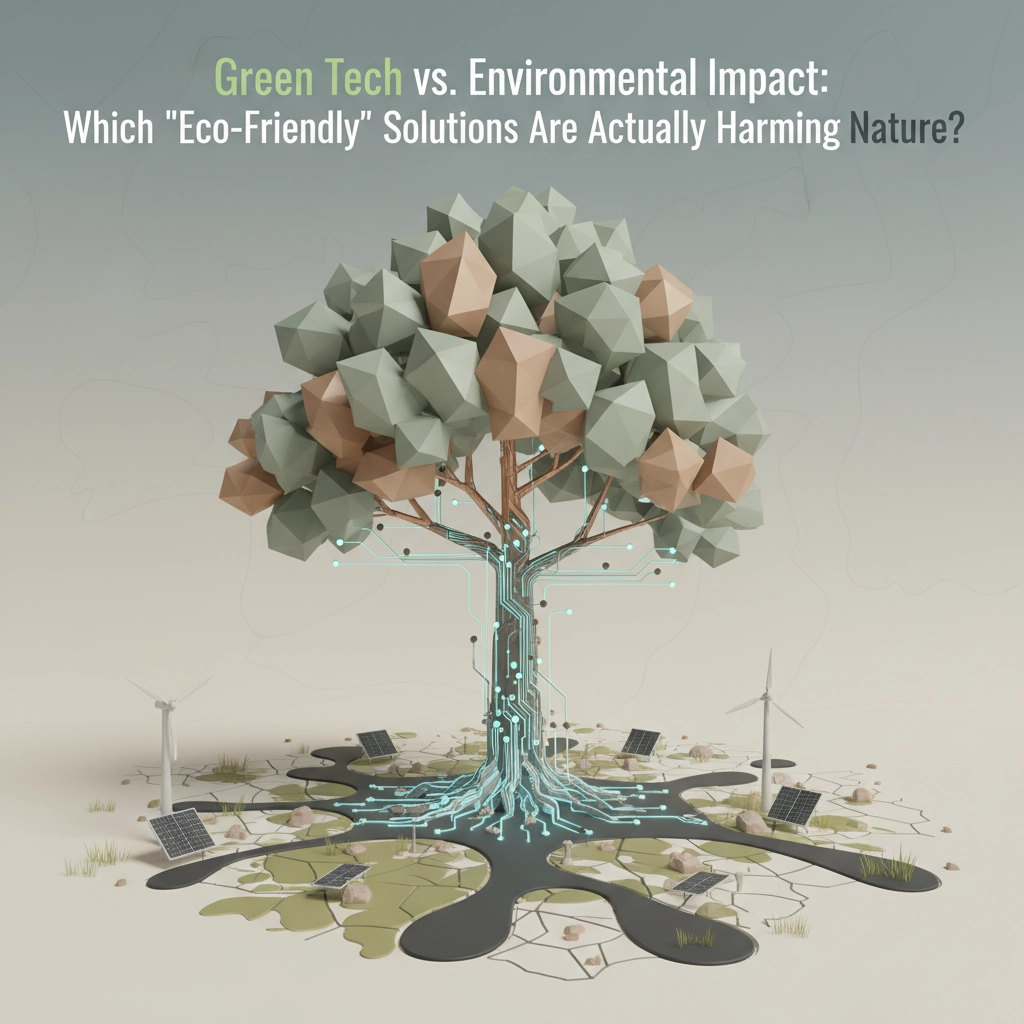
Here’s an uncomfortable truth: some of our most celebrated green technologies are quietly damaging the environment. When looking at Green Technology Environmental Impacts, we see that while we celebrate electric cars and AI-powered energy systems, we’re often blind to their hidden costs. Let’s examine which “eco-friendly” solutions might actually be harming nature.
The AI Paradox: Smart Technology, Dirty Power
Artificial intelligence promises to revolutionize sustainability. However, AI’s environmental footprint tells a different story. Training a single AI model like GPT-3 consumed 1,287 megawatt hours of electricity. That’s enough to power 120 average American homes for an entire year.
Moreover, this process generated 552 tons of carbon dioxide. That’s equivalent to burning 1,200 barrels of oil. The irony? We use this technology to find climate solutions.

Data centers supporting AI cannot meet demand sustainably. Companies are building new facilities faster than renewable energy can support them. Consequently, most electricity powering these “smart” systems still comes from fossil fuel plants.
Furthermore, AI systems require massive amounts of water for cooling. Large data centers consume millions of gallons daily. In drought-stricken regions, this creates additional environmental stress.
Electric Vehicle Battery Mining: The Dark Side of Clean Transportation
Here are some real green technologies environmental impacts. Electric vehicles represent hope for transportation’s future. Nevertheless, their batteries require rare earth minerals with devastating extraction costs. Lithium mining in South America is draining ancient salt flats. These ecosystems took millions of years to form.
Cobalt mining in the Democratic Republic of Congo destroys local environments. Additionally, it often involves child labor and dangerous working conditions. The social cost amplifies the environmental damage.
Meanwhile, companies like Kia are developing innovative solutions. Their new PBV Experience Center showcases purpose-built commercial electric vehicles. These specialized vehicles could reduce the need for multiple vehicle types. However, they still depend on problematic battery technologies.
Processing these minerals requires enormous energy inputs. Most facilities operate in countries with coal-heavy electrical grids. Therefore, the “clean” batteries carry significant carbon footprints before reaching vehicles.
Solar Panel Manufacturing: Clean Energy’s Dirty Secret
Solar panels generate emissions-free electricity for decades. However, their manufacturing process tells a different story. Producing silicon wafers requires temperatures exceeding 3,000 degrees Fahrenheit. This process typically relies on coal-powered electricity.
Additionally, solar panel production uses toxic chemicals. Hydrofluoric acid and other dangerous substances pose environmental risks. Manufacturing facilities often struggle with proper waste disposal.

Furthermore, most solar panels are manufactured in China. The country’s coal-dependent electrical grid means solar panels start life with substantial carbon debt. It takes years of clean operation to offset this initial environmental cost.
Panel disposal creates another challenge. Solar panels contain toxic materials that require special handling. As first-generation installations reach end-of-life, recycling infrastructure remains inadequate.
Wind Power’s Waste Problem
Wind turbines generate clean electricity without ongoing emissions. However, their environmental impact extends beyond operation. Turbine blades are made from composite materials that resist recycling.
Most wind turbine blades end up in landfills. These massive structures can be longer than football fields. They don’t decompose and occupy valuable landfill space for centuries.
Additionally, wind farms require significant land clearing. Large installations can disrupt wildlife migration patterns. Birds and bats suffer casualties from turbine collisions.

Moreover, wind turbine manufacturing requires substantial steel and concrete. These materials carry significant embodied carbon. The environmental payback period can extend several years.
The Data Center Dilemma with Real Green Technology Environmental Impacts
Cloud computing appears environmentally friendly compared to physical servers. Actually, it’s shifting environmental costs to massive data centers. These facilities consume enormous amounts of electricity and water.
Google’s data centers alone consume 15.5 terawatt hours annually. That’s more electricity than many countries use. While Google invests in renewable energy, the infrastructure demands outpace clean supply.
Cooling systems represent the largest environmental challenge. Data centers require constant temperature control. Traditional cooling methods waste significant energy and water.
Additionally, the rapid pace of technological advancement accelerates equipment turnover. Servers become obsolete quickly, creating electronic waste streams.
Greenwashing in Green Technology Environmental Impacts
Many companies exploit environmental concerns through misleading marketing. They highlight green features while hiding environmental costs. This greenwashing complicates genuine sustainability efforts.
For example, some “biodegradable” plastics only decompose under specific industrial conditions. In typical environments, they persist like conventional plastics. Meanwhile, consumers believe they’re making environmentally responsible choices.

Similarly, carbon offset programs often provide questionable environmental benefits. Some tree-planting initiatives fail to achieve promised carbon sequestration. Others displace local communities or damage existing ecosystems.
The Nuclear Question about Real Waste from Green Technology Environmental Impacts
Nuclear power generates clean electricity without carbon emissions. However, it creates long-term radioactive waste storage challenges. Additionally, uranium mining carries environmental and social costs.
Furthermore, nuclear accidents can have catastrophic environmental consequences. Fukushima and Chernobyl demonstrate the long-term risks involved. These events contaminated vast areas for generations.
Plant construction also requires enormous concrete and steel inputs. The embodied carbon in nuclear facilities is substantial. However, decades of clean operation typically offset these initial costs.
Green Technology Environmental Impacts: Finding Balance in Green Solutions
Understanding the Green Technology Environmental Impacts behind these trade-offs doesn’t mean abandoning green technology. Instead, it requires honest assessment of benefits versus costs. We need comprehensive lifecycle analyses for all environmental solutions.
For instance, electric vehicles still produce fewer emissions than gasoline cars. However, we must address battery supply chain problems. This includes developing recycling infrastructure and alternative battery chemistries.

Similarly, renewable energy remains essential for climate stability. Nevertheless, we must improve manufacturing processes and end-of-life management. Investing in recycling technology and cleaner production methods is crucial for green technology environmental impacts to mean something.
Moving Forward Responsibly
The solution isn’t rejecting green technology or their environmental impacts. Rather, we need more sophisticated approaches to environmental assessment. This includes considering full lifecycle impacts and social consequences.
Additionally, we must resist simple solutions to complex problems. Climate change requires systemic changes, not just technological fixes. This includes reducing consumption and improving efficiency.
Moreover, transparency in environmental impact reporting is essential. Companies must provide honest assessments of their products’ environmental costs. Consumers deserve accurate information to make informed choices.
Finally, continued innovation can address current green technology limitations. Better recycling methods, cleaner manufacturing processes, and alternative materials offer hope. However, these improvements require sustained investment and research.
Green technology represents our best hope for environmental sustainability, but the Green Technology Environmental Impacts of today’s solutions cannot be ignored. Nevertheless, we must acknowledge and address their current limitations. Only through honest assessment can we build truly sustainable solutions for our planet’s future.
For more insights into sustainable innovations, explore our coverage of algae-powered city lights and other emerging technologies on Green Living Guy.
Sources: