Two Chargers on 106th Street: The Real Fight Over New York City EV Charging Curbside Space Isn’t About the Cars
New York City wants to add two electric vehicle (EV) charging spots on West 106th Street.
The proposed locations are 13 W. 106th St. and 200 W. 106th St. Both sites sit in Manhattan Valley. Both would use Level 2 curbside chargers.
At first, this sounds like a small infrastructure announcement. It is not.
The plan has opened a larger debate about what New York City’s curb space should do. Should it store private vehicles? Support electric taxis? Serve e-bikes? Create loading zones? Protect bike lanes? Add trees? Help people with disabilities?
The honest answer is that the curb cannot do everything at once.
That makes this one of the hardest versions of the New York City EV charging problem. Our recent Forest Park fast-charging story focused on a major public win: 10 fast chargers, more access, and a new option for drivers without home charging.
The Manhattan Valley proposal is different. It forces us to discuss the
trade-off.
What New York City EV Charging is proposing
The New York City Department of Transportation proposed the two Manhattan Valley EV charging locations in August 2026. They form part of a larger plan to add 600 curbside charging stations across the city during the next three years.
The program is called the Curbside Level 2 Electric Vehicle Charging Expansion Program. It supports Mayor Zohran Mamdani’s administration goal of reaching net-zero greenhouse gas emissions by 2050.
The New York City EV charging stations will definitely serve drivers who lack private garages and driveways. They could also support high-mileage drivers, including taxi and ride-share operators who work for companies such as Uber and Lyft.
The New York City DOT EV charging plan says it will focus on high-density neighborhoods that lack charging access. That focus matters. A homeowner with a driveway can install a charger. A renter who parks on the street cannot.
The city’s existing curbside network already shows strong demand. According to the DOT, its 88 public curbside charging points are occupied more than 70 percent of the time.
That number is the strongest argument for expansion.
You do not add more New York City EV charging because the existing ones sit empty. You add them because drivers use them. The utilization data shows that curbside charging has moved beyond a symbolic pilot. It now serves a real transportation need.

Why residents are pushing back on the New York City EV Charging
The objections deserve more than a dismissive response.
One resident wrote on the Upper West Side in New York City feedback page: “This is a short street and will ruin the charm.”
Another wrote: “This policy discriminates against the poor by favoring those who can pay $$$$ for expensive EV cars and takes away already limited FREE public parking spaces.”
Other comments raised concerns about congestion and the loss of space for electric bikes.
These residents are not rejecting clean air. They are responding to a familiar New York City EV charging reality. Every curb decision removes another possible use.
Professor Dong Guo of Columbia’s School of International and Public Affairs described the problem clearly. The curb is a public good, but it has limited space.
“The bus lanes, bike lanes, loading zones, and there’s dining areas outside,” Guo said. “All of those are competing for the same space, the same curb.”
That competition creates opportunity costs. A charger may help one public goal while making another goal harder.
Manhattan Valley EV Chargers : Essential Curb Space and Equity
Professor Jonathan Stiles of Columbia’s Graduate School of Architecture, Planning, and Preservation made a similar point. He called curb and street space one of the city’s best opportunities to transform urban life. The city could use that space for electrification, green areas, transit, walking, biking, or congestion reduction.
Therefore, the question should not be, “Are EVs good?”
The real question is, “What public benefit should this specific piece of curb provide?”
Free parking is not a neutral baseline
New York City has roughly 3 million curbside parking spaces. About 97 percent are free, according to a 2024 Hunter College urban policy and planning study.
That fact changes the parking argument.
When someone says the city is taking away “FREE public parking,” the word free does important work. The space is public. The vehicle is private. Leaving that vehicle on public land without a direct charge is already a subsidy.
Free parking is not a natural right. It is a policy choice.
Stiles argued that New York EV charging has the right to definitely charge a reasonable fee for curb use. He also discussed residential parking permits. Those permits could prevent nonresidents from taking local spaces while giving neighborhood residents a clearer claim to the public space near their homes.
That approach would not eliminate conflict. However, it could make the rules more transparent.
The city could also charge for idling, use time-based congestion pricing, and create fees for larger vehicles. Guo pointed to Chinese cities that subsidize both charger installation and charger use. That approach could encourage demand while supporting public access.

The equity objection cuts both ways for New York City EV Charging
The concern about expensive EVs is real.
Many electric cars still cost too much for low-income households. A curbside charger can look like a public investment that primarily serves wealthier drivers.
Guo acknowledged that resentment can grow when a community feels that a project does not serve local residents.
“There can be resentment, because you’re not really serving them,” he said.
The city must take that warning seriously. It should publish charger usage by neighborhood. It should report who uses the chargers. It should track pricing, access, and availability. It should also make sure the program does not become a premium service for affluent private-car owners.
However, the equity case does not end there.
The DOT is specifically targeting neighborhoods with many TLC-licensed drivers. Taxi and
ride-share drivers often work long hours, drive enormous annual mileages, and spend heavily on fuel and maintenance. Cleaner vehicles could lower operating costs and reduce tailpipe pollution in the communities where these drivers work.
Moreover, EVs are used vehicles, not only new luxury cars. Our used EV market coverage has tracked falling prices, growing off-lease supply, and more models below $30,000.
A charging network built only for homeowners with private garages would be less equitable. Curbside charging reaches renters. It reaches apartment residents. It reaches working drivers. It can also reach people who need a car for mobility but cannot install equipment at home.
The disability question changes the debate for New York City EV Charging
Michael Gerrard of Columbia Law School offered the most important reminder.
He does not see public transit and electric vehicles as an either-or choice. Some residents with disabilities depend on cars. Transit cannot meet every mobility need.
That means the city should electrify necessary car trips while also improving transit, walking, and biking.
“Both public transit and electric vehicles are important parts of that policy, not necessarily competing with each other,” Gerrard said.
This point deserves its own policy lane.
A cleaner car still takes road space. It still contributes to congestion. It does not solve traffic by itself. As Guo put it, “Swapping internal combustion engine onto an EV doesn’t really solve that problem.”
Still, replacing a gasoline car with an EV reduces tailpipe pollution. That matters for pedestrians, cyclists, transit riders, outdoor workers, and people living near busy streets.
The best transportation policy does both things. It reduces unnecessary car trips. It also cleans up the car trips that remain.
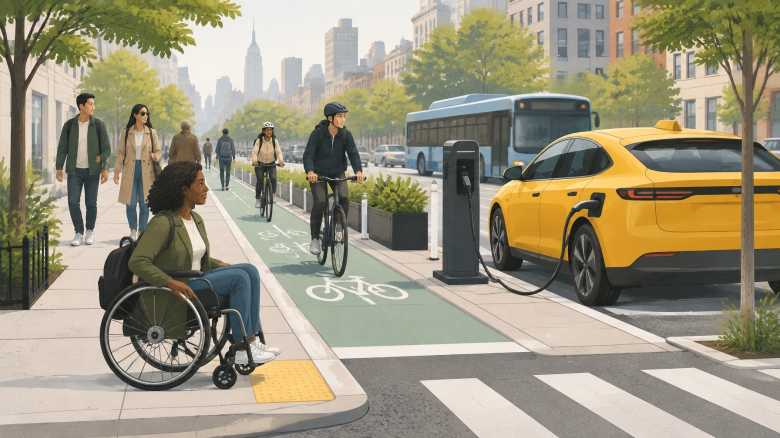
One New York City EV charging space can serve many drivers
There is another point that rarely receives enough attention.
A conventional parking space may hold one vehicle for hours. A charging space can serve multiple vehicles in a day. Drivers arrive, charge, and leave.
That makes an EV charging space more land-use efficient than a space used for long-term vehicle storage. The benefit depends on enforcement and pricing, of course. If a driver leaves a fully charged car in the space all day, the advantage disappears.
The city should therefore use time limits, idle fees, and clear signage. A charger should not become a free parking space with an electrical cable attached.
Our verdict: Build the chargers, but measure the trade-off
Stiles is right that transit, walking, and biking provide the biggest quality-of-life gains. They move more people with less pollution and less space.
Guo is right that New York City EVs do not cure congestion and nor do chargers.
Gerrard is also right. Electric vehicles remain necessary for trips that transit cannot serve. That’s especially including trips made by some residents with disabilities.
These arguments support more transportation investment. They do not support stopping curbside charging.
Two proposed charging locations on a city with 3 million curbside spaces represent a tiny land-use change. Moreover, the city’s 70 percent-plus charger occupancy shows that the underlying demand is real.
Opposing any change to a short residential block may protect parking. It does not automatically protect transit, affordability, or sustainability.
Still, New York City should not treat community feedback as an obstacle. It should treat it as part of the design process. The DOT should publish clear usage data, set fair prices, protect accessible parking, prevent charger hogging, and evaluate whether the stations serve local residents and TLC drivers.
The curb is contested. Pretending otherwise would be greenwashing by omission.
The right answer is not to stop building chargers. It is to decide deliberately what the curb is for, and then make the public benefit visible.
If your city proposes curbside charging, participate in the comment process like in New York City. Review the locations. Ask how the city will measure utilization and equity. Support better design rather than automatic opposition.
In Manhattan Valley, the two chargers are small. The policy question is enormous.
Acknowledgments
Green Living Guy thanks Columbia Spectator reporters Lara Harmankaya and
Devin Schwartz for their reporting, as well as Professors Dong Guo, Jonathan Stiles, and Michael Gerrard for contributing thoughtful perspectives on charging access, curb management, transportation equity, and disability mobility. We also acknowledge the NYC Department of Transportation and the residents who submitted public comments.
Outside sources
- Columbia Spectator: Manhattan Valley to receive two new EV charging spots
- NYC DOT: Expansion of curbside electric vehicle charging
- NYC DOT Projects: Curbside Level 2 Electric Vehicle Charging Expansion Program