A viral LinkedIn post recently described South Korea’s Solar canopy bridges over Seoul’s Han River.
It presented one spectacular structure with innovative design and ambitious purpose.
Cleaner infrastructure is not limited to solar projects. Our report on high-speed rail in America explains why another transportation alternative has struggled to scale.
The post connected sustainable energy solutions with urban architecture.
It aims to provide a new pathway for pedestrians and cyclists.
It also serves as a symbol of renewable energy and environmental consciousness.
The bridge would harness solar power, generating clean energy and enhancing the urban landscape.
Fact-Check
That Solar canopy claim requires fact-check.
The famous Paik Nam June Media Bridge was never built. Planning Korea designed the concept in 2010. It featured solar panels, gardens, museums, water-taxi docks, and a futuristic mini-city above the river.

Design-boom
, Dezeen, eVolo, and other publications shared the renderings widely.
However, the project remained a concept. No completed solar bridge of that design spans the Han River.
The real story is still impressive. South Korea has completed practical projects that place Solar canopy infrastructure over bicycle paths, along transport corridors, and beside waterways. These projects offer a better lesson than the viral image. They show how infrastructure can serve several purposes at once.
Viral myth versus built reality
| Viral claim | What the evidence shows |
|---|---|
| Seoul has a massive solar-powered Paik Nam June bridge | The 2010 design remains unbuilt |
| A continuous solar highway runs 32 kilometers between Daejeon and Sejong | The overall corridor is about 32 kilometers, but the covered bike path is much shorter |
| Solar panels are replacing normal infrastructure | The strongest projects add energy generation to infrastructure that already exists |
| The main benefit is electricity | Shade, safety, public access, and local benefits matter just as much |
That distinction matters. Good environmental journalism should not turn an architectural rendering into a completed project.
The Paik Nam June Media Bridge was a vision, not a bridge
Planning Korea’s proposal imagined a 1,080-meter structure across Seoul’s Han River. It would have carried cars, pedestrians, and cyclists. It also included cultural facilities, retail space, gardens, and docking stations for boats.

The concept’s surface would have used solar panels to generate electricity. The design also proposed rainwater collection and planted areas. In other words, it imagined a bridge as a city, park, power plant, and cultural destination.
This ambitious idea sparked excitement and wonder among those who heard about it. It promised to revolutionize the way we interact with the world around us, offering innovative solutions and groundbreaking possibilities.
The Solar canopy concept, though unrealized, remains a point of discussion in design circles. However, despite the enthusiasm and energy surrounding this concept, it was also never built, leaving many to ponder the ‘what ifs’ and imagine how different things might have been had it come to life.
The concept remains useful because it introduced a powerful question: Why should a bridge perform only one job? Still, readers deserve to know where the drawings end and the built environment begins.
Sihwa’s solar bicycle path puts the idea into practice
The most clearly documented recent example is Gyeonggi Solar Bicycle Path No. 1 at the entrance to the Sihwa Barrage in Siheung, Gyeonggi Province, which serves not only as a recreational space for cyclists but also as a testament to innovative renewable energy solutions. This impressive path spans several kilometers, seamlessly integrating solar panels along its route to provide sustainable energy for lighting and other amenities. Visitors can enjoy picturesque views of the surrounding landscape, as well as access various facilities that enhance their biking experience, such as rest areas and informational signage about the local ecology and the importance of renewable resources. The project highlights the region’s commitment to environmentally friendly infrastructure while encouraging outdoor activities among residents and tourists alike.
The project opened in March 2026. It covers approximately 840 meters of an existing bicycle path with a design-integrated solar canopy.
Installed Capacity System
The system has an installed capacity of about 761.6 kilowatts, or kW. Capacity describes the maximum instantaneous output of the equipment under favorable conditions.
The project is expected to produce approximately 1.02 million kilowatt-hours, or kWh, each year. A kWh measures the amount of electricity generated or consumed over time. Therefore, 761.6 kW describes the size of the system, while 1.02 million kWh describes its expected annual energy production.
The project also used a different financing model. Private investors provided approximately 1.7 billion won in capital. The project did not require an upfront public expenditure.
That is the detail American cities should study.
Reportedly, project revenue will support public amenities. Those include rest areas, exercise equipment, bicycle facilities, and nighttime lighting. The project therefore does more than produce electricity. It returns value to the people who use the path.
The Gyeonggi Environmental Energy Promotion Agency describes this approach as “living-adjacent infrastructure.” In plain English, that means infrastructure people experience during everyday life.
Solar power becomes more visible when it shades a bike ride, lights a public space, or supports a rest stop. That visibility can make the energy transition feel practical instead of abstract.
The Daejeon–Sejong corridor is real, but viral descriptions oversimplify it
South Korea’s Daejeon–Sejong solar bicycle route is another widely shared example of innovative infrastructure that promotes sustainable transportation and renewable energy use. This impressive pathway not only provides a scenic route for cyclists, allowing them to enjoy the beautiful landscapes of the region, but it also integrates solar panels along its length, harnessing the sun’s energy to power nearby facilities and lighting. The initiative reflects a growing trend in urban development focused on eco-friendliness and carbon neutrality, encouraging citizens to utilize bicycles as a convenient and environmentally responsible mode of transportation.
The full intercity corridor stretches roughly 32 kilometers between Daejeon and Sejong. However, the covered bicycle path does not run continuously beneath solar panels for the entire distance.
Reports describe a protected bicycle route of roughly 8.8 to 9 kilometers within the larger road corridor. The solar canopy covers approximately 4.6 to 4.8 kilometers of that route. About 7,502 solar panels reportedly produce approximately 2,200 megawatt-hours of electricity annually.
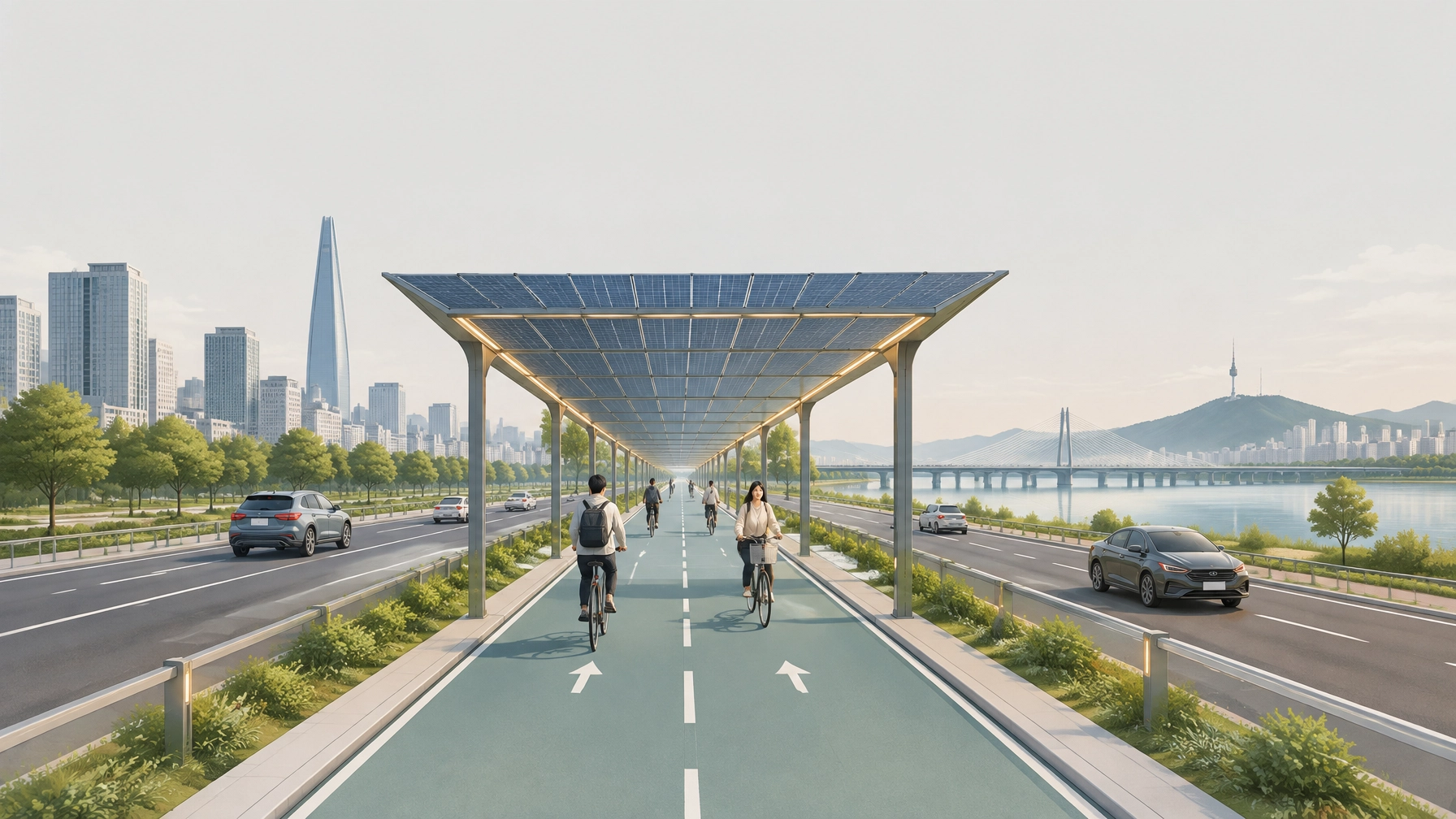
The route places cars on both sides. A physically separated bicycle path runs through the center. The canopy sits above the path.
That arrangement reverses the usual road hierarchy. Instead of treating cyclists as an afterthought at the edge of a highway, the design gives them a direct and protected route. Cyclists can also enter and exit through separated access points.
The canopy provides shade during hot weather. It also protects riders from rain. As a result, cycling becomes more practical for commuting. That matters because a bike route should serve transportation, not only weekend recreation.
The shade also reduces direct solar radiation on the pavement. This can lower surface temperatures and may help reduce heat stress on the path. More research would be useful, but the design clearly offers benefits beyond electricity generation.
Why South Korea keeps building solar infrastructure over public space
South Korea has limited land. It is also mountainous, densely populated, and dependent on imported energy.
Those conditions create pressure to use land carefully. Large solar farms can provide substantial electricity, but they can also compete with farmland, forests, and open space.
That is why South Korea offers an important case study for the principle we have emphasized at the Green Living Guy: use rooftops, parking lots, brownfields, canals, and other disturbed surfaces before converting productive farmland or natural areas.
Our solar power coverage explores the same basic idea. Solar does not need to occupy every available field. It can often sit above the places where people already live, work, travel, and park.
This is also the logic behind large solar carports. A parking lot can store cars, provide shade, support electric-vehicle charging, and generate power. A bicycle canopy can protect riders, improve mobility, lower pavement heat, and produce electricity.
That is multi-purpose infrastructure.
Distributed generation brings power closer to the load
The Korean projects also demonstrate distributed generation.
Distributed generation means producing electricity close to where people use it. A solar canopy over a bike path may supply nearby lighting, public displays, charging equipment, or local facilities. It does not need to send every electron across a distant transmission network.
That proximity can reduce grid congestion and transmission losses. It can also improve resilience. If a local system includes solar, storage, and essential loads, a community facility may continue operating during a disruption.
Our coverage of thermal energy storage and New York’s Forest Park charging hub examines the same broader principle: the vehicle, building, charger, and energy system should work together.
The limits are real
Solar bridges and canopies are not automatically better than rooftops or ground-mounted arrays.
First, they cost more. Engineers must design for wind, rain, snow, drainage, waterproofing, structural loads, and public safety. Maintenance crews must also work above a public path or roadway.
Second, the panels may not face the sun at the ideal angle. That can reduce radiance, which means the amount of solar energy reaching a surface. The value of these projects comes from using otherwise difficult space, not from achieving the highest possible panel efficiency.
Third, roads create safety concerns. A canopy above traffic must withstand crashes, debris, vibration, and severe weather. Repairs must happen without placing drivers, cyclists, or workers at unnecessary risk.
Dust, snow, and thermal buildup can also reduce output. Cleaning adds cost.
Finally, the numbers remain modest compared with national electricity demand. The Sihwa project’s 761.6 kW is not a national power solution. It is a local energy asset. That is the correct way to evaluate it.
A million kilowatt-hours per year can support lighting, amenities, and local facilities. It does not replace a power plant.
More Korean examples show the model expanding
South Korea is testing this approach in several forms.
Reports have described solar-panel guardrails along the Gyeongin Ara Waterway. In that design, the barrier reportedly produces electricity while also discouraging dangerous access to the water. Safety and generation share one structure.
Floating solar on Soyang Lake has also been reported as a project designed to share clean-energy profits with local residents. That benefit-sharing model resembles the Sihwa bicycle path.
Meanwhile, Gangdong-gu announced a 4.9-kilometer Hangang Greenway in September 2026. The planned project includes a green pedestrian bridge and targets completion in 2030. It shows that new river infrastructure can still combine transportation, public space, and ecological goals.
A September tender from the Chungcheongbuk-do Office of Education also included solar equipment for Cheongsan Bridge and a school solar program. The project is smaller, but it illustrates how public agencies can retrofit existing structures one site at a time.
The lesson for American cities
South Korea’s best solar infrastructure is not a futuristic bridge that never left the drawing board.
It is the ordinary-looking canopy over a bicycle path. It is the solar structure above an existing public space. It is the private financing model that funds community amenities. It is the decision to give cyclists shade and protection instead of asking them to ride beside fast traffic.
Seth Leitman, the Green Living Guy, has consistently argued that businesses and communities should prioritize rooftops, parking lots, and already-disturbed surfaces before turning to farmland or open space. South Korea shows how that principle can extend beyond buildings.
A bridge can carry people and produce power. A parking lot can shade cars and support charging. A bike path can improve public health and generate electricity.
That is the real story behind South Korea’s solar bridges.
Acknowledgment: Thank you to Seth Leitman, Planning Korea, the Gyeonggi Environmental Energy Promotion Agency, Gyeonggi Province, South Korean local agencies, The Asia Business Daily, ABC News, Dezeen, and the Korean regional outlets whose reporting and project data helped make this fact-check possible.